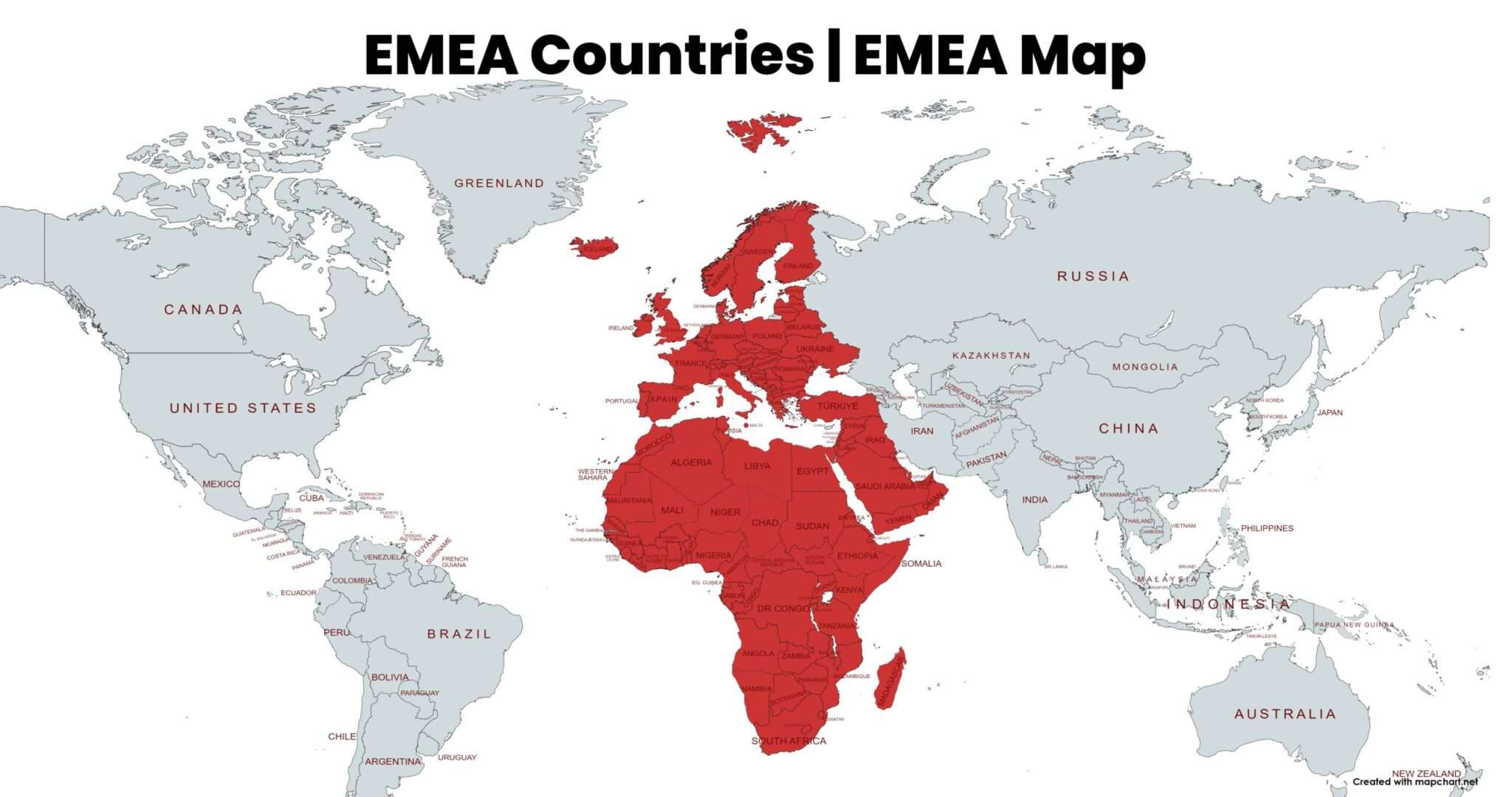
EMEA stands for Europe, the Middle East and Africa. It is a business region: global companies use it to run sales, marketing and operations for these three areas with one team and one budget. This page lists every EMEA country by region, with flags and a map, and compares EMEA with MENA, MEA, APAC and other regional codes.
What Is EMEA?
EMEA is one way to divide the world into regions for business. A company that sells in many countries often has three regions: the Americas (AMER), Asia-Pacific (APAC) and EMEA. Each region usually has its own leadership, budget and targets.
Companies use EMEA mostly for sales and marketing planning, and also for operations, customer support and logistics. Many North American and Asian companies start with one EMEA team when they enter the region. As the business grows, they split EMEA into smaller regions, such as Western Europe, the Nordics, the Middle East or Africa, each with its own team.
There is no official definition of EMEA. Each company decides which countries it includes, so two EMEA lists are rarely the same. The list on this page follows the most common business definition.
How Many Countries Are in EMEA?
There is no fixed number, because every company sets its own list. The list below has 114 countries: 45 in Europe, 15 in the Middle East and 54 in Africa. Some companies also include 8 countries from the Caucasus and Central Asia, which makes 122.
EMEA Countries List
The tables group the EMEA countries by region and sub-region. Sub-regions for Europe and Africa follow the UN geoscheme. Three countries could sit in two places. Turkey and Russia are in both Europe and Asia: we list Turkey with the Middle East and Russia with Europe. Egypt is in Africa, but marketing plans often group it with the Middle East. We list it with Africa.
EMEA Countries in Europe (45)
| Country | Sub-region |
|---|---|
 Albania | Southern Europe |
 Andorra | Southern Europe |
 Austria | Western Europe |
 Belarus | Eastern Europe |
 Belgium | Western Europe |
 Bosnia and Herzegovina | Southern Europe |
 Bulgaria | Eastern Europe |
 Croatia | Southern Europe |
 Cyprus | Southern Europe |
 Czechia (Czech Republic) | Eastern Europe |
 Denmark | Northern Europe |
 Estonia | Northern Europe |
 Finland | Northern Europe |
 France | Western Europe |
 Germany | Western Europe |
 Greece | Southern Europe |
 Hungary | Eastern Europe |
 Iceland | Northern Europe |
 Ireland | Northern Europe |
 Italy | Southern Europe |
 Latvia | Northern Europe |
 Liechtenstein | Western Europe |
 Lithuania | Northern Europe |
 Luxembourg | Western Europe |
 Malta | Southern Europe |
 Moldova | Eastern Europe |
 Monaco | Western Europe |
 Montenegro | Southern Europe |
 Netherlands | Western Europe |
 North Macedonia | Southern Europe |
 Norway | Northern Europe |
 Poland | Eastern Europe |
 Portugal | Southern Europe |
 Romania | Eastern Europe |
 Russia | Eastern Europe |
 San Marino | Southern Europe |
 Serbia | Southern Europe |
 Slovakia | Eastern Europe |
 Slovenia | Southern Europe |
 Spain | Southern Europe |
 Sweden | Northern Europe |
 Switzerland | Western Europe |
 Ukraine | Eastern Europe |
 United Kingdom | Northern Europe |
 Vatican City | Southern Europe |
EMEA Countries in the Middle East (15)
The Middle East part of EMEA covers the six Gulf (GCC) states, the Levant, and Iran, Iraq, Turkey and Yemen. For a closer look at this part of the region, see our guide to the MENA region and its countries.
| Country | Sub-region |
|---|---|
 Bahrain | Gulf (GCC) |
 Iran | Other Middle East |
 Iraq | Other Middle East |
 Israel | Levant |
 Jordan | Levant |
 Kuwait | Gulf (GCC) |
 Lebanon | Levant |
 Oman | Gulf (GCC) |
 Palestine | Levant |
 Qatar | Gulf (GCC) |
 Saudi Arabia | Gulf (GCC) |
 Syria | Levant |
 Turkey (Türkiye) | Other Middle East |
 United Arab Emirates (UAE) | Gulf (GCC) |
 Yemen | Other Middle East |
EMEA Countries in Africa (54)
All 54 African countries are part of EMEA. The North African countries are also part of MENA.
| Country | Sub-region |
|---|---|
 Algeria | North Africa |
 Angola | Central Africa |
 Benin | West Africa |
 Botswana | Southern Africa |
 Burkina Faso | West Africa |
 Burundi | East Africa |
 Cabo Verde (Cape Verde) | West Africa |
 Cameroon | Central Africa |
 Central African Republic | Central Africa |
 Chad | Central Africa |
 Comoros | East Africa |
 Côte d'Ivoire (Ivory Coast) | West Africa |
 Democratic Republic of the Congo | Central Africa |
 Djibouti | East Africa |
 Egypt | North Africa |
 Equatorial Guinea | Central Africa |
 Eritrea | East Africa |
 Eswatini (Swaziland) | Southern Africa |
 Ethiopia | East Africa |
 Gabon | Central Africa |
 Gambia | West Africa |
 Ghana | West Africa |
 Guinea | West Africa |
 Guinea-Bissau | West Africa |
 Kenya | East Africa |
 Lesotho | Southern Africa |
 Liberia | West Africa |
 Libya | North Africa |
 Madagascar | East Africa |
 Malawi | East Africa |
 Mali | West Africa |
 Mauritania | West Africa |
 Mauritius | East Africa |
 Morocco | North Africa |
 Mozambique | East Africa |
 Namibia | Southern Africa |
 Niger | West Africa |
 Nigeria | West Africa |
 Republic of the Congo | Central Africa |
 Rwanda | East Africa |
 São Tomé and Príncipe | Central Africa |
 Senegal | West Africa |
 Seychelles | East Africa |
 Sierra Leone | West Africa |
 Somalia | East Africa |
 South Africa | Southern Africa |
 South Sudan | East Africa |
 Sudan | North Africa |
 Tanzania | East Africa |
 Togo | West Africa |
 Tunisia | North Africa |
 Uganda | East Africa |
 Zambia | East Africa |
 Zimbabwe | East Africa |
Countries Some Companies Add to EMEA (8)
Some companies also run the Caucasus and Central Asia from their EMEA team. Others put these countries in APAC or in a separate CIS region.
| Country | Sub-region |
|---|---|
 Armenia | Caucasus |
 Azerbaijan | Caucasus |
 Georgia | Caucasus |
 Kazakhstan | Central Asia |
 Kyrgyzstan | Central Asia |
 Tajikistan | Central Asia |
 Turkmenistan | Central Asia |
 Uzbekistan | Central Asia |
EMEA and Other Regional Acronyms
These are the regional codes you will see most often next to EMEA.
| Acronym | Meaning | Compared with EMEA |
|---|---|---|
| EMEA | Europe, the Middle East and Africa | The full region |
| EEMEA | Eastern Europe, the Middle East and Africa | EMEA without Western Europe |
| CEEMEA | Central and Eastern Europe, the Middle East and Africa | EEMEA with Central Europe added |
| SEMEA | Southern Europe, the Middle East and Africa | Only the south of Europe, plus the Middle East and Africa |
| EMEIA | Europe, the Middle East, India and Africa | EMEA plus India |
| MEA | Middle East and Africa | EMEA without Europe |
| MENA | Middle East and North Africa | A smaller region inside EMEA |
| MENAT | Middle East, North Africa and Turkey | MENA plus Turkey |
| MENAP | Middle East, North Africa, Afghanistan and Pakistan | MENA plus Afghanistan and Pakistan |
| DACH | Germany, Austria and Switzerland | A sub-region inside EMEA |
| APAC | Asia-Pacific | A separate region: East, South and Southeast Asia, Australia and New Zealand |
| AMER | The Americas | A separate region: North, Central and South America |
Why Companies Use EMEA
EMEA joins very different markets, but grouping them is practical. Most EMEA countries are within a few hours of Central European Time, so one team can work with the whole region in the same working day. One regional head office can also report on a few regions instead of dozens of separate countries.
Where the Middle East Fits in an EMEA Plan
In many EMEA plans, the Middle East is run from Europe in English, which misses a large audience. There are more than 450 million Arabic speakers, and many of them prefer to search, shop and read in Arabic. A campaign written in Arabic for the market usually performs better than one translated from English.
If the Middle East is part of your EMEA plan, treat it as one region with real differences inside it. Gulf, Levantine and North African audiences use different dialects, platforms and payment methods. GOTOMENA is a native Arabic marketing agency based in Europe. We help EMEA teams plan and run Arabic SEO, Arabic Google Ads and Arabic social media marketing for the region. To start, read our guide on how to enter the MENA market or contact our team.